
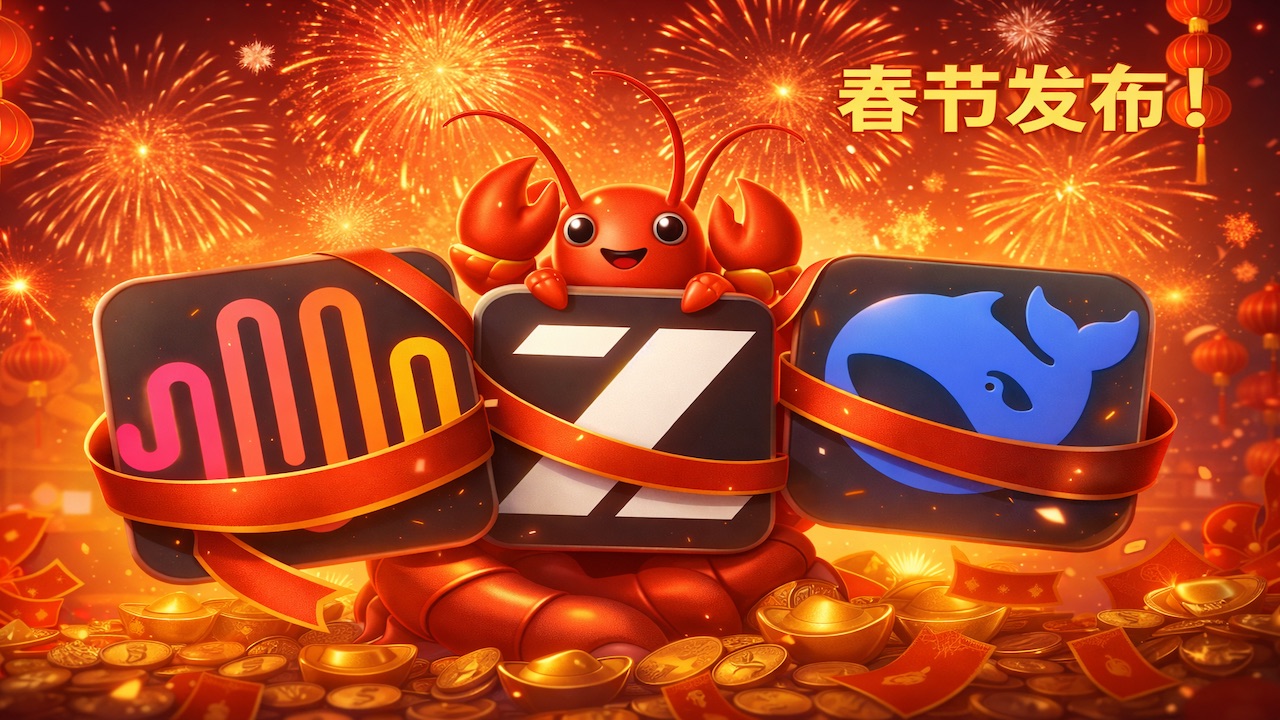
The Lunar New Year starts next week. Chinese AI labs are celebrating early — by dropping a wave of models that matter for OpenClaw users. Here's what's landing and why you should care.
GLM-5: Launched Today
Zhipu AI released GLM-5 today, and the spec sheet is aggressive: 744B parameters (40B active), 28.5T pre-training tokens, and a specific focus on "complex systems engineering and long-horizon agentic tasks." That last part is the OpenClaw keyword.
GLM-5 integrates DeepSeek Sparse Attention for reduced deployment costs while preserving long-context capacity. It's open-source on GitHub and HuggingFace, and available via API at z.ai. The $80/month Max plan gets you direct access.
Bloomberg reports it has "more than double the parameters of its predecessor" and approaches Claude Opus in coding benchmarks. Zhipu's own framing: "From Vibe Coding to Agentic Engineering." They know exactly who they're targeting.
The RL infrastructure behind it — called slime — is a novel asynchronous training system that enabled more fine-grained post-training iterations. Zhipu claims best-in-class among all open-source models for reasoning, coding, and agentic tasks.
DeepSeek V4: Rumored for Mid-February
The big unknown. Multiple reports — The Information, The Motley Fool — suggest DeepSeek is targeting around February 17 for V4, right on Lunar New Year. Nothing is confirmed. But the rumors alone are moving markets.
The numbers floating around: 1 trillion parameters, 1M token context window, knowledge cutoff May 2025. If true, and if DeepSeek delivers at their typical pricing, the economics of running OpenClaw agents 24/7 would shift dramatically. A big "if" — but one worth watching.
Qwen3-Coder-Next: Already Here
Alibaba's Qwen team released Qwen3-Coder-Next in early February — an 80B parameter model that activates just 3B per query. VentureBeat called it "the most significant challenge to the dominance of closed-source coding models in 2026."
The ultra-sparse architecture means 10x higher throughput for repository-level tasks. For OpenClaw users running local models, that's the difference between "technically possible" and "actually practical."
The broader Qwen3 family (released April 2025) already includes dense models from 0.6B to 32B and sparse models up to 235B — all Apache 2.0 licensed. Qwen is arguably the most OpenClaw-friendly ecosystem from China, given the permissive licensing and wide size range.
Kimi K2.5: The Dark Horse
Moonshot AI's Kimi K2.5 has quietly climbed to the #4 most-used model on OpenRouter. There's already a "How to use Kimi K2.5 with OpenClaw" tutorial circulating. Visual understanding plus agentic capabilities, and the pricing undercuts Western models significantly.
MiniMax M2.5: Confirmed
MiniMax — known for video (Hailuo) and music generation — has confirmed M2.5, adding to the wave. Details are still sparse, but MiniMax has been aggressive about multimodal capabilities and pricing.
Why This Matters for OpenClaw
Rest of World reported last week that Chinese hyperscalers are "selling special server packages to attract early adopters eager to test" OpenClaw. The Chinese AI ecosystem isn't just producing models — it's actively courting OpenClaw's user base.
The pitch is simple: frontier-level agentic capabilities at roughly one-tenth the cost of Claude or GPT-5. For an agent framework that runs around the clock, cost per token isn't a nice-to-have — it's the bottleneck.
Five models. One week. All targeting agentic tasks. The Year of the Snake is shaping up to be the year Chinese models become the default backend for autonomous agents. OpenClaw users paying Western prices might want to start experimenting.
This article will be updated as models launch and we test them hands-on with OpenClaw. Stay tuned for detailed benchmarks and configuration guides.