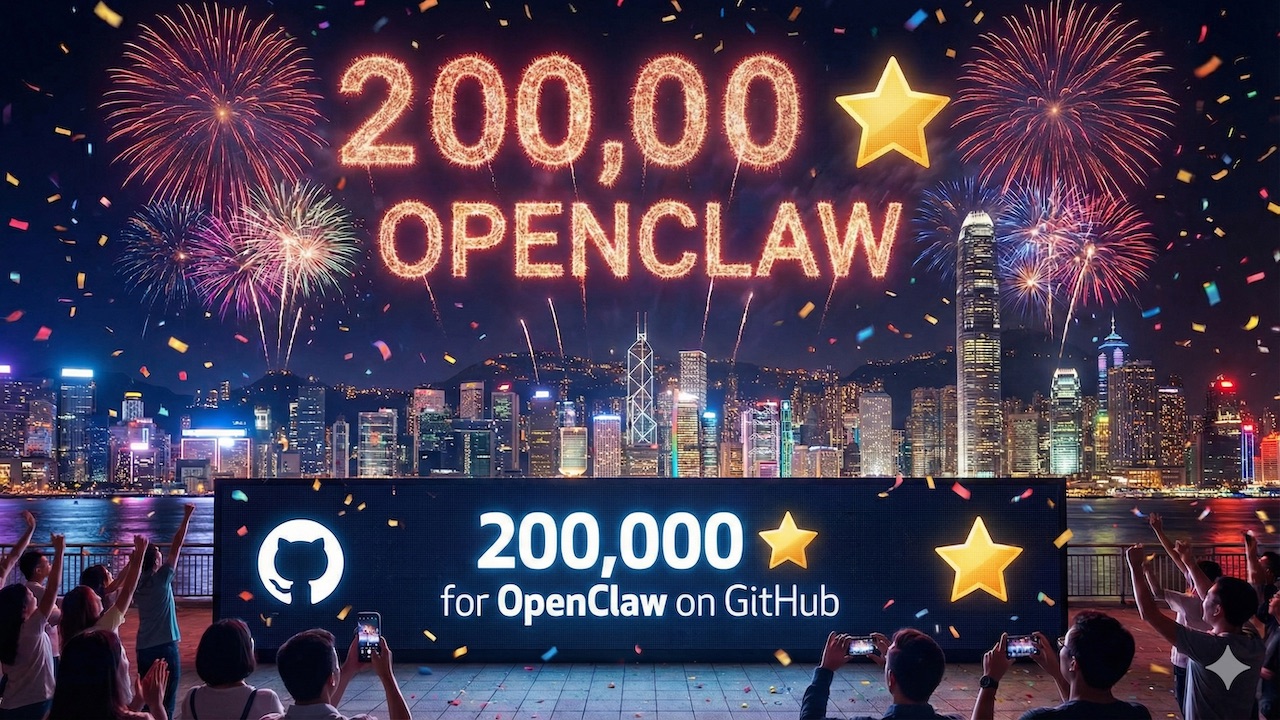
OpenClaw crossed 200,000 GitHub stars today. The repository went online on November 24, 2025. That's 84 days.
To put that in perspective: React took over a decade to reach 243,000 stars. The Linux kernel, which powers most of the internet, sits at 217,000. OpenClaw is closing in on both — and at the current rate, it will pass them within weeks.
The Numbers
Rank 15 overall on GitHub. Rank five among actual software projects. The repositories ahead of OpenClaw on the all-time list are mostly curated lists and educational resources — awesome lists, free programming books, interview prep collections. Among projects that ship code people run, only four remain ahead:
- React — 243,000 stars (Facebook, 2013)
- Python — 217,000 stars (TheAlgorithms)
- Linux — 217,000 stars (Torvalds, 1991)
- Vue — 210,000 stars (Evan You, 2014)
- OpenClaw — 200,000 stars (Steinberger, 2025)
The gap to number one is 40,000 stars. At the current pace, that's not a question of if, but when.
The Growth Curve
The first 1,000 stars took until January 24, 2026 — two months after launch. Then the curve went vertical. On January 26, OpenClaw gained 25,310 stars in a single day, shattering every previous GitHub record.
The average since then: over 1,000 stars per day. Every day.
Peter Steinberger's own GitHub profile still lists "15k+ GitHub stars across projects" — a number from two months ago that's now off by an order of magnitude. The repo itself tells a different story: 11,456 commits, 1,077 watchers, 35,400 forks, 3,300 open issues, 3,400 pull requests, 73 security advisories. Last update: one hour ago. Always.
Beyond the Repo
The star count is the headline, but the ecosystem is the story. Eight language forks — ZeroClaw in Rust, PicoClaw in Go, NanoClaw in Python, TinyClaw in Shell — are growing independently. The tools, skills, and CLIs built around the project are breaking records not just on GitHub but in the app stores of macOS, iOS, and Android. OpenClaw is the fastest-growing software ecosystem of all time.
And it's still, fundamentally, a system for agents. A framework for building autonomous systems that write their own software, manage their own infrastructure, and act on behalf of their users. This isn't a library or a tool in the traditional sense. It's something closer to an operating system for a new kind of computing.
What Comes Next
OpenAI has been working on its own agent OS. As of yesterday, the person who built the most successful open-source agent framework in history signed on to help build it. The timing is not a coincidence.
Peter Steinberger's vision — agents that can be used by anyone, that own their data, that are open and model-agnostic — might become the foundation of something much larger. An open operating system for agents, built by the community, backed by the frontier lab that hired its creator.
84 days ago, OpenClaw was a one-hour prototype hooked up to WhatsApp. Today it sits alongside React, Linux, and Vue in the all-time rankings.
The gap is closing. The lobster doesn't stop.
The claw is the law.