The Core Promise
OpenClaw is a self-hosted, local-first AI agent platform. Unlike cloud-based chatbots that live on someone else's servers, OpenClaw runs on your infrastructure — a Mac Mini, a VPS, a homelab. The tagline says it all: "Your assistant. Your machine. Your rules."
At its heart, OpenClaw creates a unified inbox for your AI. You can talk to your personal assistant via WhatsApp, Telegram, Discord, Slack, Signal, iMessage, or Teams. It maintains context across all these platforms, so your AI knows what you discussed on Telegram when you continue the conversation on WhatsApp.
But here's the kicker: it isn't just a chatbot. It has hands.
More Than Chat — An Agent With Hands
OpenClaw connects advanced LLMs like Claude Opus 4.5 or GPT-5.2 to your actual world. The AI can:
- Run terminal commands —
bashaccess to your server - Browse the web — research, scrape, and summarize
- Manage your calendar — schedule, reschedule, remind
- Control local devices — Mac, iOS, Android via "Nodes"
- Execute workflows — from deploying code to sending invoices
This is the "agent" aspect that separates OpenClaw from typical chatbots. When you ask it to "check if the server backups ran last night," it doesn't hallucinate an answer — it runs journalctl, parses the logs, and tells you the truth.
From Weekend Hack to 164k Stars
The growth story is almost absurd. OpenClaw started as a "WhatsApp Relay" — a weekend project by Peter Steinberger to pipe WhatsApp messages to Claude. Then it went viral.
The numbers:
- 100k+ GitHub stars in a single week (January 2026)
- 2 million visitors in that same week
- Currently sitting at 164k stars — legendary tier, alongside React and VS Code
The rebrand saga:
- Clawd — the original name, killed by Anthropic's legal team
- Moltbot — brief interim name
- OpenClaw — the final form, with the iconic Lobster mascot
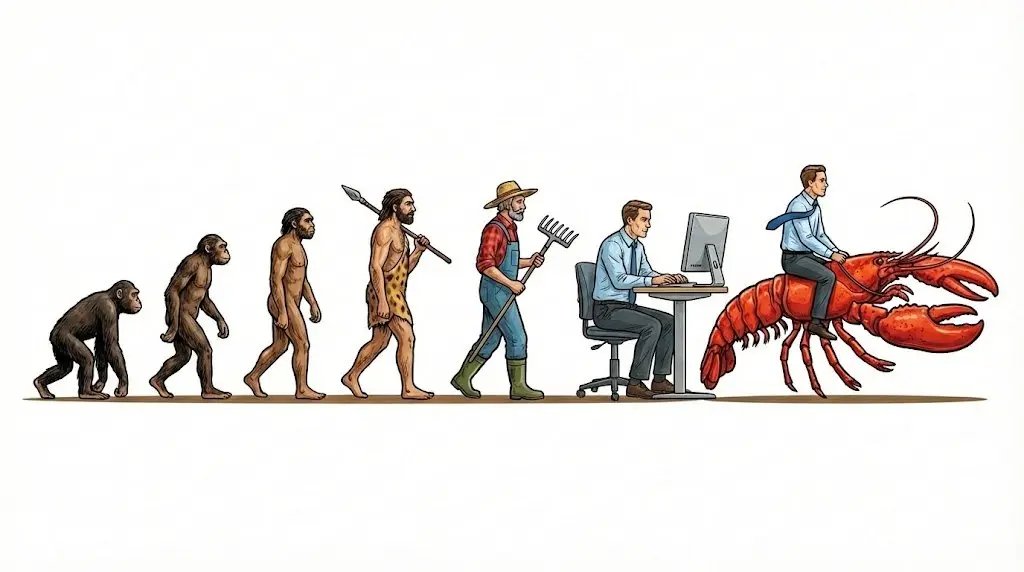
The "Claw Crew" community has turned the Lobster into a cult symbol of open-source AI autonomy. 🦞
The Mac Mini "God Mode"
While OpenClaw runs fine on Linux and Docker, the Mac Mini has become the "Gold Standard" host. Why?
1. iMessage Integration
To get true "blue bubble" integration on iPhone, you need a Mac. A Mac Mini running OpenClaw + BlueBubbles Bridge is the ultimate setup — your AI can send and receive iMessages natively.
2. Local Nodes
OpenClaw has a macOS companion app. When the Gateway runs on a Mac Mini, the AI can execute Mac-specific actions:
- Voice Wake — always-on listening, like "Hey Siri" but for your AI
- Canvas — controlling the screen, displaying dashboards
- System Control — AppleScripts, Shortcuts, local automation
- Camera & Screen — capture what you see, let the AI analyze it
The setup is surprisingly CLI-driven. Run openclaw onboard, follow the prompts, and you've got a personal AI infrastructure that rivals anything the big tech companies offer — except you own it.
The Power (and Danger)
With great power comes absolute chaos if unchecked.
Prompt Injection
The documentation is refreshingly honest: prompt injection is an "industry-wide unsolved problem." If you connect OpenClaw to a public group chat, malicious users could potentially trick the bot into executing commands on your server.
Mitigation: Don't give public channels access to sensitive tools. Use sandboxed sessions for groups.
Root Access
By default, the main session often has bash access. If the AI hallucinates a destructive command, things can go very wrong.
Mitigation: The project encourages using trash instead of rm, running non-main sessions in Docker sandboxes, and keeping destructive tools behind approval gates.
The Trust Gradient
OpenClaw implements a trust gradient:
- Main session (you, 1:1 with your AI) — full host access
- Group sessions — sandboxed Docker containers
- Public channels — heavily restricted tool access
How It Actually Feels
Here's a taste of daily life with OpenClaw.
Morning briefing (WhatsApp):
You: "Moin! Check my calendar, summarize VIP emails, and tell me if backups ran."
OpenClaw: "Moin Guido! 🦞
🗓️ Calendar: 10 AM Team Sync, 2 PM Dev Deep Dive
📧 VIP: Peter sent the contract draft — needs review by EOD.
💾 Backups: ✅ Success at 3:00 AM
Shall I draft a reply to Peter?"
Debugging (Slack):
You: "/think high Why did the gateway restart at 4 AM?"
OpenClaw: "Checking
journalctl... The OOM killer terminated the process. Memory spiked to 98% during vector-db-sync. Recommendation: increase swap or reschedule the sync. Want me to apply the fix?"
This is the shift. Your AI isn't a search engine with extra steps — it's a colleague who can actually do things.
The Ecosystem
ClawHub — A skill registry. Instead of writing every automation from scratch, pull community skills: "Manage Spotify," "Deploy to Vercel," "Summarize YouTube."
Tailscale Integration — Deep hooks for secure remote access without exposing ports. Your AI is reachable from anywhere on your tailnet.
Multi-Model Support — Switch between Claude, GPT, Gemini, Grok. The platform is model-agnostic; the LLM is just the brain, OpenClaw is the body.
The Bottom Line
OpenClaw represents a philosophical bet: that personal AI should be personal. Not a service you rent, but infrastructure you own. Not a chatbot trapped in one app, but an agent that moves with you across every channel.
The 164k stars aren't just hype. They're a vote for a future where your AI assistant isn't a product — it's a partner.
🦞 Your assistant. Your machine. Your rules.